Victor Frankenstein’s achievement is inseparable from his refusal to remain with it. He succeeds in making life and recoils from the being that now depends on him. The moral problem begins where a simpler invention story might end.
Mary Shelley’s novel was first published in 1818 and revised in 1831. Reading the book rather than relying on its cultural shorthand reveals an argument built from competing accounts. Victor tells his story, the creature tells his, and Walton’s letters provide another enclosing perspective.
A voice inside the image
The creature’s capacity for speech changes the terms of the encounter. He is not only an object to be inspected. He can explain what exclusion feels like and challenge the person who brought him into existence.
His suffering does not erase the violence he commits. The novel’s difficulty lies in holding recognition and responsibility together. Understanding a grievance is different from excusing every action taken in its name.
Read beyond the laboratory
The book spends much of its energy on education, companionship and the consequences of rejected obligations. Its landscapes enlarge those questions: pursuit continues through spaces in which human ambition looks both powerful and very small.
For a first reading, notice who is allowed to describe an event before another voice replies. Shelley makes sympathy move. The result is a novel about creation whose sharpest question concerns continuing care: after making something possible, who stays to answer for what happens next?
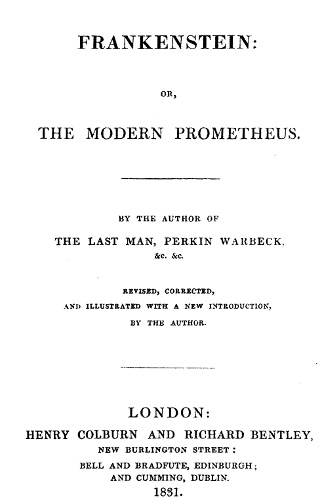
Text and records consulted: Mary Shelley, Frankenstein, 1831 edition.
Image: Historic Frankenstein title-page scan. Public domain. Image record. Archival image; not a photograph of a current event.