
The great movement in Pride and Prejudice is a revision of judgment. Elizabeth Bennet must reconsider Darcy, but she must also reconsider the confidence with which she reads everyone else. Austen makes that second task the more demanding one.
Elizabeth is observant, funny and often right. Those qualities make her mistakes persuasive. A reader who enjoys her wit can become invested in her conclusions before the evidence deserves it. The novel turns that pleasure into a quiet examination of how intelligence can cooperate with vanity.
Money inside the marriage plot
First published in 1813, the book places courtship inside a system of property and dependence. The Bennet daughters cannot simply treat marriage as a private expression of feeling. Charlotte Lucas makes the practical stakes especially clear: security has a price, and refusing that price requires resources that are not equally available.
That pressure gives the comedy its edge. Invitations, visits and conversations are entertaining because they are so carefully observed; they matter because a household’s future can be negotiated through them.
What to notice on a reread
Pay attention to the difference between a good account of an event and a convincing performance. Wickham’s ease and Darcy’s awkwardness encourage an early mistake: confusing social fluency with moral reliability. Austen gradually separates them.
Our monthly selection rewards readers who enjoy dialogue and an exacting social comedy. Its lasting pleasure is not simply watching two people find one another. It is watching them become capable of a less convenient truth.
Text and records consulted: Jane Austen, Pride and Prejudice.
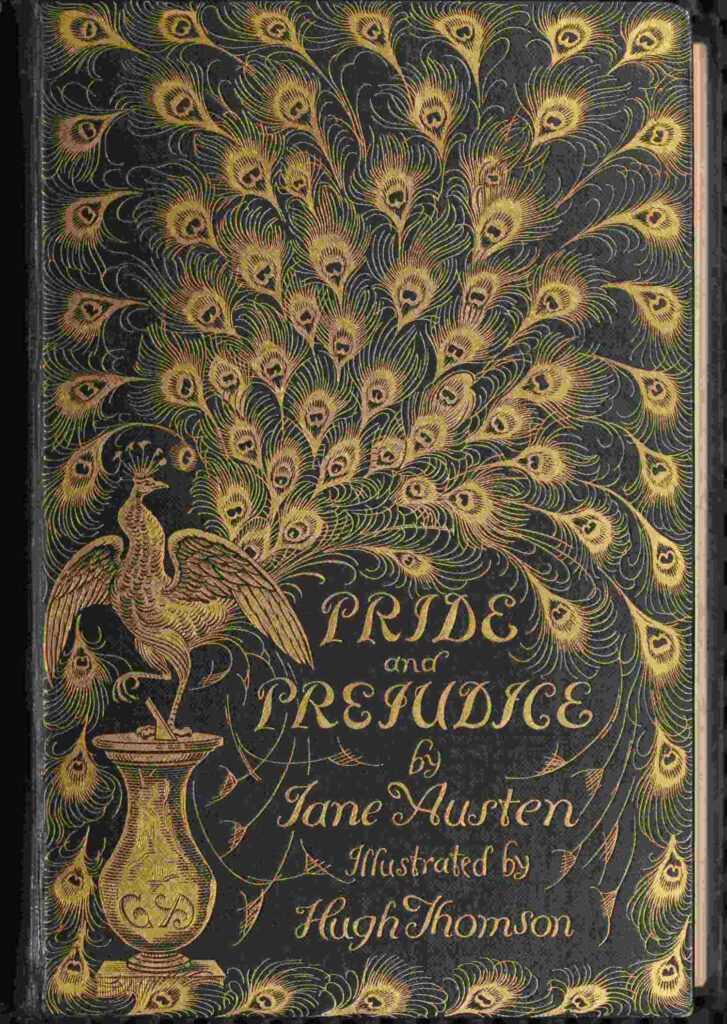
Image: Historic binding reproduced in the Hugh Thomson illustrated edition. Public-domain scan. Image record. Archival image; not a photograph of a current event.