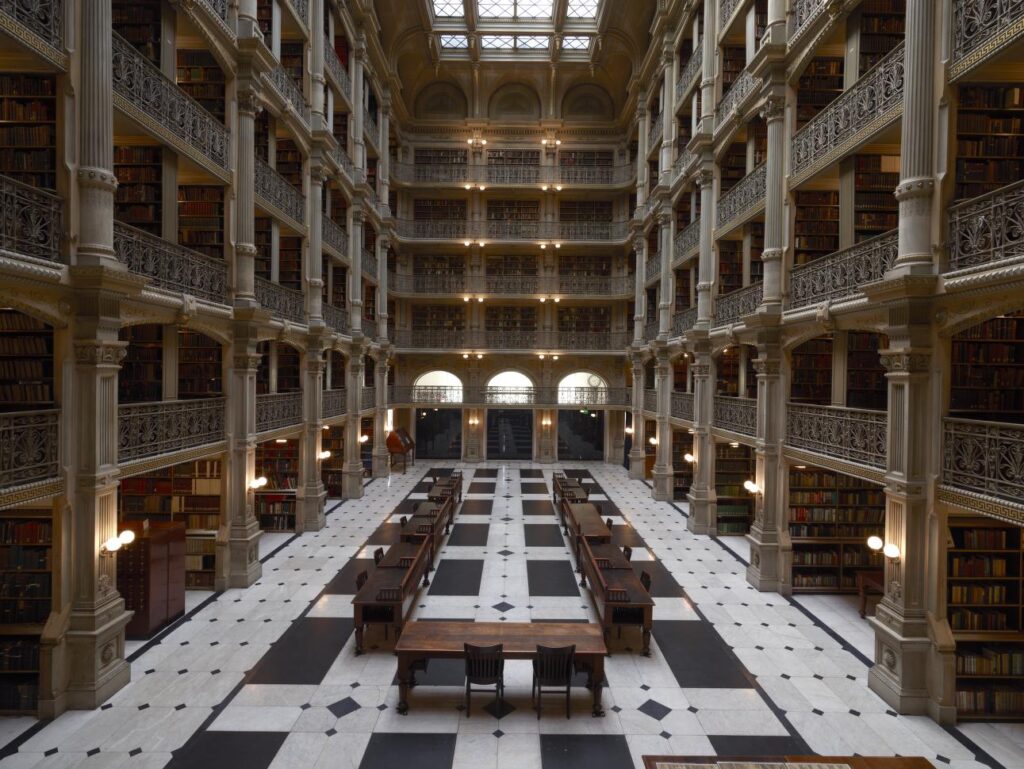
The George Peabody Library in Baltimore turns storage into a visible architectural idea. In Carol M. Highsmith’s 2012 photograph, repeated tiers of balconies draw the eye upward while the open central space keeps the collection in view.
The Library of Congress catalog dates the building’s opening to 1878 and identifies Edmund G. Lind as its architect, working with the institute’s first provost, Nathaniel H. Morison. Those historical details help explain why the room deserves attention beyond its considerable visual appeal.
A room organized around books
Here the shelves are not hidden behind a reception area. They help establish the room’s scale and rhythm. A visitor can understand that a collection is large without first reading a statement about its importance.
There is a useful distinction between admiring that arrangement and assuming that visual grandeur guarantees access. A photograph cannot tell us every rule governing the use of a building. It can show how a culture chooses to represent the act of study.
Look at the structure
Notice the relationship between the central floor and the upper tiers. The architecture gives individual reading a setting larger than the individual reader. That is the image’s lasting proposition: a book may be encountered privately, while the place that preserves it can express a collective ambition.
Text and records consulted: Library of Congress, George Peabody Library photograph and catalog record.
Image: Highsmith, Carol M., 1946-, photographer. 2012 September.. Library of Congress. No known restrictions on publication. Image record. Archival image; not a photograph of a current event.