Mary Shelley’s Frankenstein gives its readers several points of entry. Walton writes letters. Victor recounts his life. The creature offers an account that challenges the meaning of Victor’s. Each speaker changes the pressure on the story already told.
Structure as an ethical choice
The arrangement prevents a single response from settling too easily. Victor’s suffering can command attention before the creature has explained his own. Once that explanation arrives, the reader must reconsider the distribution of sympathy.
The question is not whether every speaker is equally reliable. It is what becomes possible when a person previously described from outside is permitted to speak.
Read the introduction separately
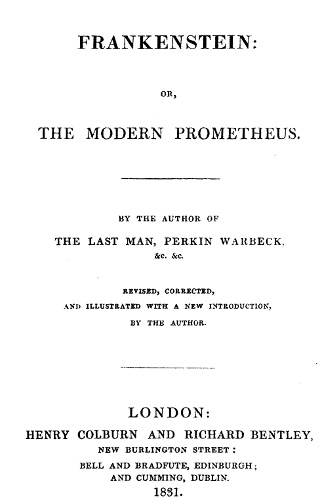
Shelley’s 1831 introduction also belongs to the book’s history. It looks back at the novel’s origins from a different moment than its first publication in 1818. Treating that later account as part of the reading experience is useful, provided the two dates are not collapsed.
A practical approach is to read the novel with attention to its transitions between speakers, then return to the introduction. The comparison separates the author’s retrospective account from the voices she created.
This author focus is a literary essay based on Shelley’s published work. It is not an interview or a claim of personal access to the writer.
Text and records consulted: Mary Shelley, Frankenstein, 1831 edition and introduction.
Image: Historic Frankenstein title-page scan. Public domain. Image record. Archival image; not a photograph of a current event.