
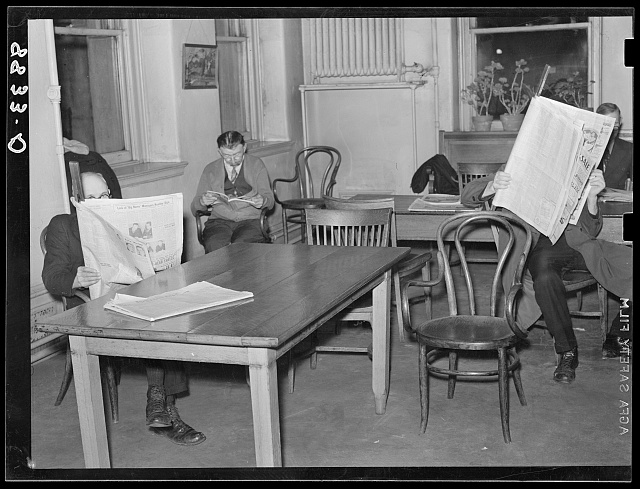
John Vachon’s photograph of a newspaper reading room in Omaha, Nebraska, was made in November 1938. Preserved by the Library of Congress, it records an ordinary setting in which people encountered the news together.
The room matters as much as the newspapers. Tables, seating and the presence of other readers make information part of a physical arrangement. Reading can be solitary without taking place alone.
What the image can support
A photograph offers evidence of a particular scene, not a complete account of an institution. It cannot tell us what each reader believed or how widely every newspaper circulated. Its value lies in the specific details it preserves and the questions those details make possible.
Here one such question concerns access. A reading room creates an opportunity to encounter publications without each person possessing every copy. The setting makes the distribution of information visible.
An archive of ordinary attention
Historical images are often valued for dramatic events. This one rewards attention to a routine. The act of sitting down with a newspaper is familiar, but the material conditions around it have changed.
Looking carefully at that difference offers a useful corrective to accounts of media history built only around devices. Information also has a history of rooms, habits and shared facilities.
Text and records consulted: Library of Congress, John Vachon, Newspaper reading room, Omaha, November 1938.
Image: Vachon, John, 1914-1975, photographer. 1938 Nov.. Library of Congress. No known restrictions. For information, see U.S. Farm Security Administration/Office of War Information Black & White Photographs https://www.loc.gov/rr/print/res/071_fsab.html Image record. Archival image; not a photograph of a current event.